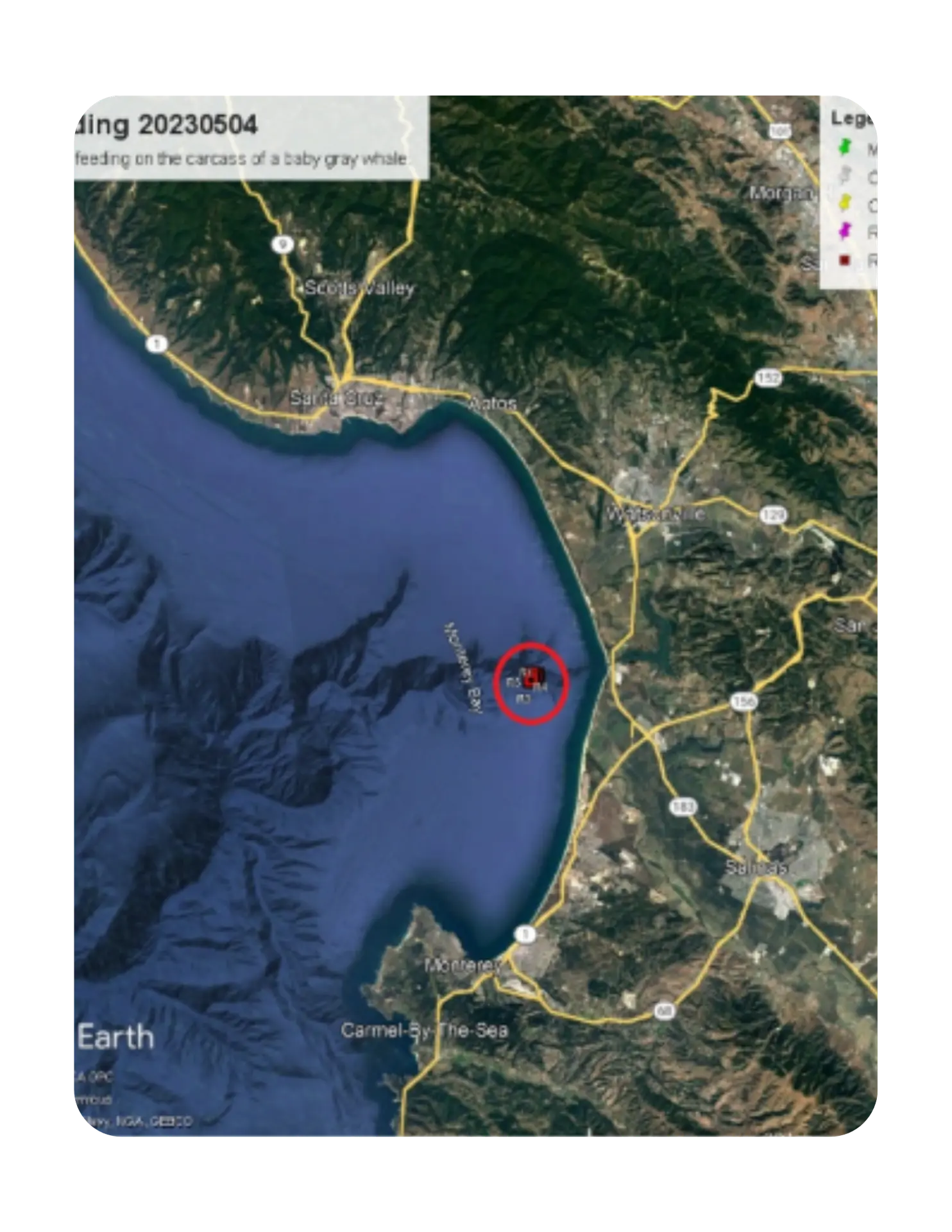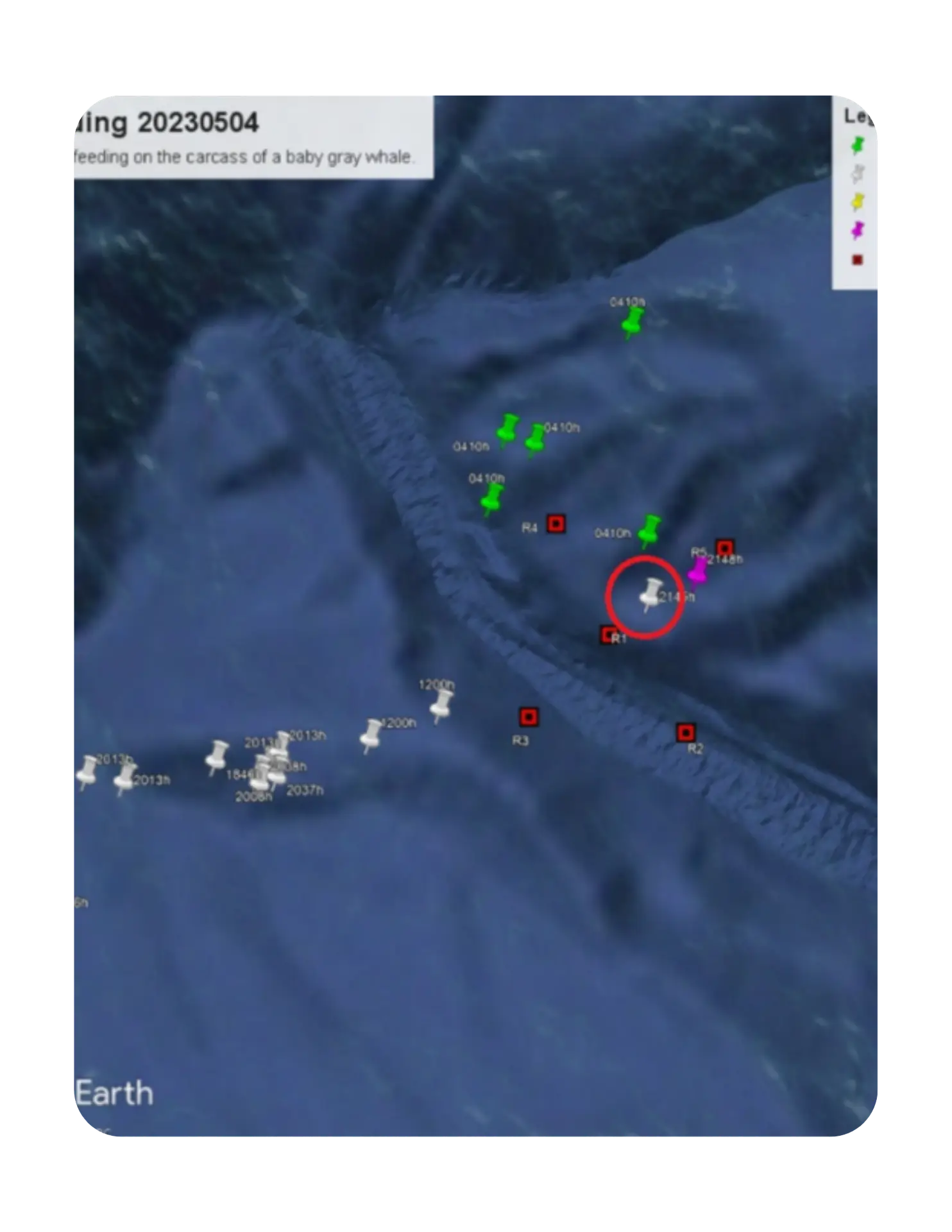
May 3, 2110h PDT | The Initial Contact
In the evening of May 3, 2023 the array successfully detected a group of humpback whales. The whales were localized swimming just north of the array's perimeter (green pushpins in red circle).
May 4, 0500h PDT | The Approach
Early the following morning, the SonarPoint system detected and tracked killer whales approaching from the southwest.
May 4, 1146h PDT | Visual Confirmation
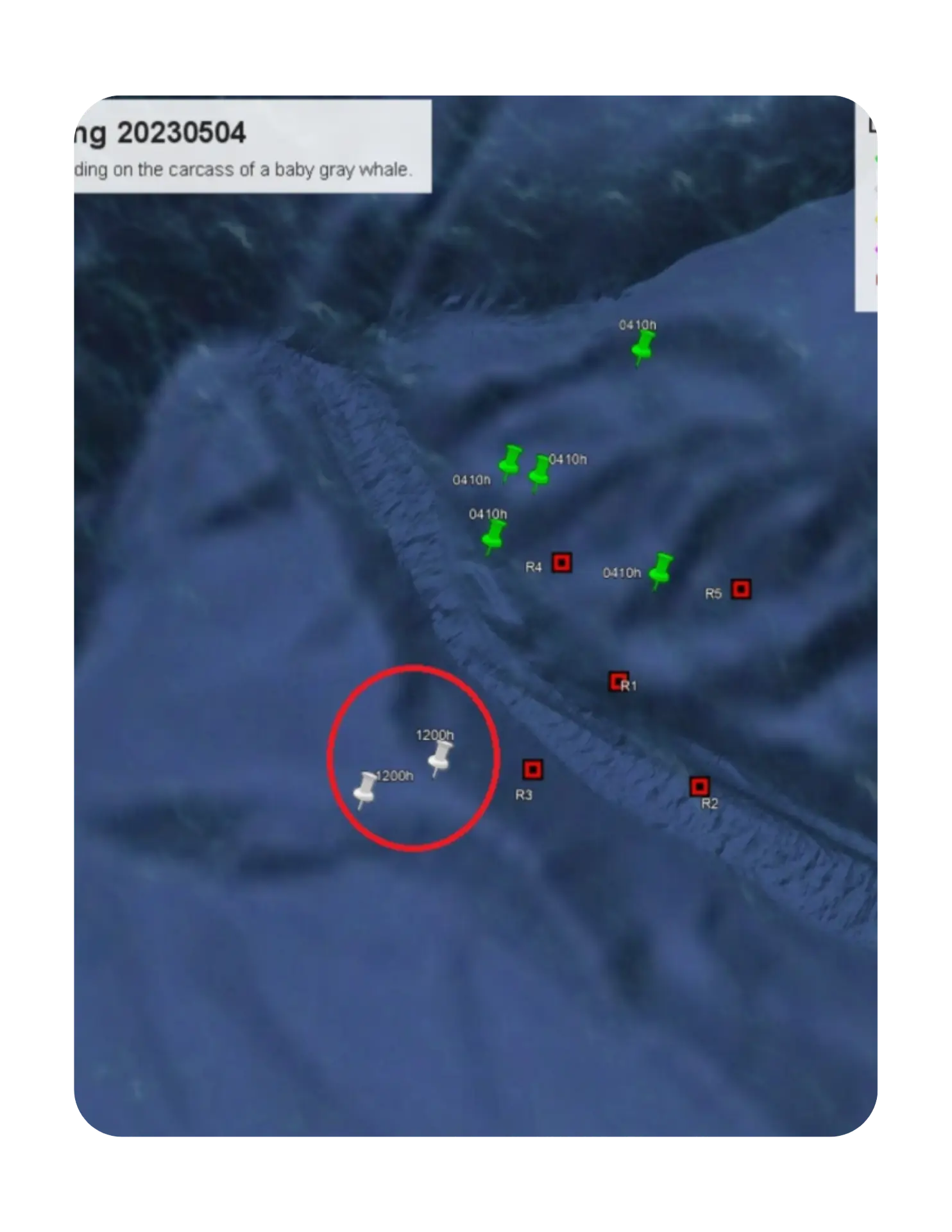
By noon, Jeff Jacobsen aboard the R/V Scarlett (purple pushpin) noted killer whale activity to the southwest of the array (yellow pushpin). A few whale watching boats were nearby, observing but there was no visual sign of feeding activity such as an oil slick on the surface. Nonetheless, Jeff and Jodi observed distinct high-arch breaches and dives by the killer whales indicating they were not migrating, but targeting something directly below.
SonarPoint simultaneously detected highly active killer whale acoustics below (white pushpins).
May 4, 1146h PDT | Visual Confirmation
Our design features offer a range of tools to create visually stunning websites. Utilize WYSIWYG editors, drag-and-drop building blocks, and Bootstrap-based templates for effortless customization. With professional themes and an intuitive system, you can design with ease and precision, ensuring a polished, responsive result.
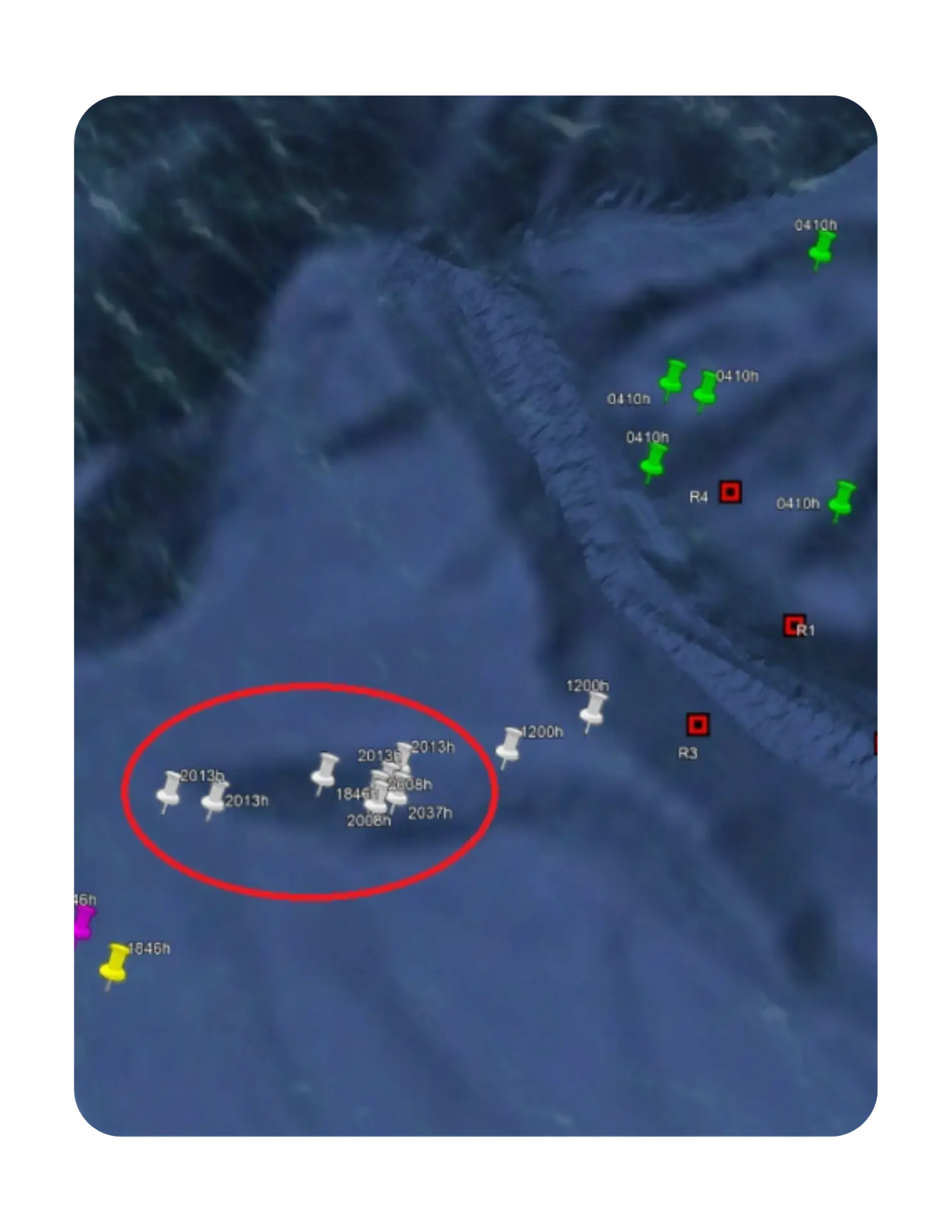
May 4, 1337h PDT | Submerged Feeding
Early that afternoon, many SonarPoint acoustic localizations clustered tightly together, indicating some sort of an active event below the surface.
May 4, 1448h PDT | The Surface Reveal
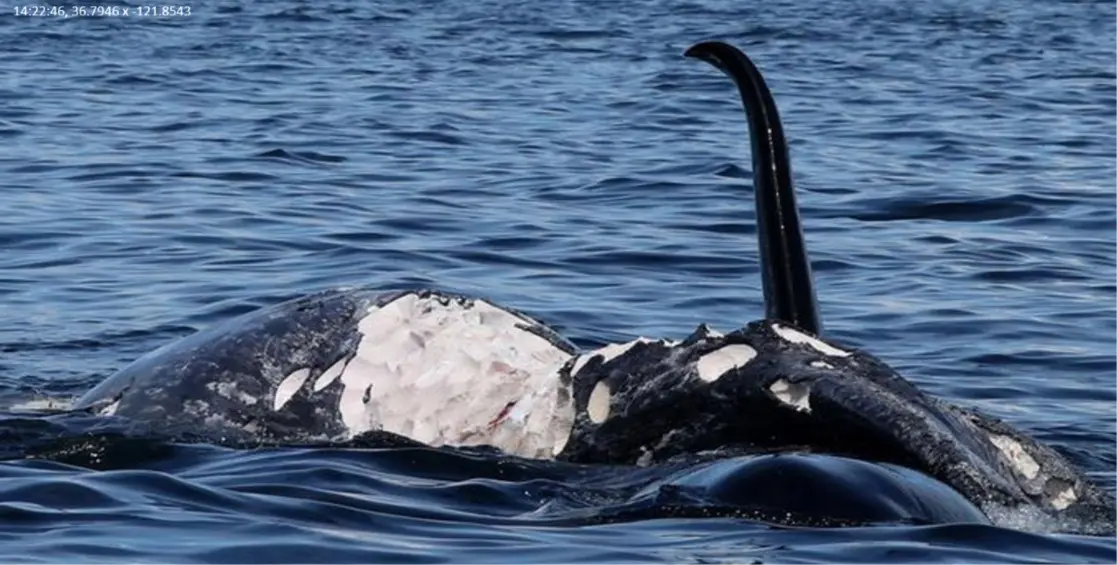
Within the next hour, the killer whale acoustic detections shifted to the northeast corner of the array. It was then that the R/V Scarlett along with other boats in the whale watching fleet visually observed a gray whale calf carcass surfacing. The visual observation matched the acoustic sound localizations, culminating in the photograph of the male killer whale carrying the shark-bitten carcass. While enthusiasts were observing with their cameras from the whale watching boats, Jeff deployed a hydrophone over the side and broadcast the many killer whale calls that could be heard over the din of the boat engines on his VHF radio. Quickly, the boats cut their engines, giving the enthusiasts a richer picture combining what they saw and what could be heard.
Passive Acoustic Monitoring (PAM) systems have long been a staple of marine mammal research. As a practical Localizing PAM array (L-PAM), SonarPoint is the next logical step for this technology. And while in 2023 we were still in the early learning curve, this story shows how L-PAM acoustic datasets can tell comprehensive stories. An obvious use case is to produce more accurate cetacean density estimates. But potentially, the datasets might also serve to underpin detailed behavioral studies of cetaceans across ocean observation areas spanning hundreds of square miles. Along this exploration, revisiting and analyzing the full SonarPoint dataset of the fascinating events of May 3 – 4, 2023 may be an excellent starting point.