DiveTrackerUnderwater navigation for divers
A transmitter marks your boat, buddy or dive site. The receiver in your hand leads you back, even in zero visibility.
How DiveTracker works
One unit marks the target. The other leads you back to it.
DiveTracker uses underwater sound, so it works when you can't see. The transmitter sends regular sonar pings; the handheld receiver shows how strong they are.
- 01Mark the destination. Hang the transmitter on the anchor line, under the boat, on your buddy or at a site you want to find again. It pings in every direction except straight up.
- 02Sweep the receiver. Hold it level and turn a full circle, comparing signal strength as you go. The strongest reading shows the likely direction. Echoes and obstructions can still mislead, so sweep again as you swim.
- 03Swim and re-check. Head toward the strongest signal and sweep again now and then. The indicator also gives an approximate distance.
Scout vs Sport
Scout is the smaller, simpler set for everyday dives. Sport adds range, sensitivity controls and a more detailed display, in a larger receiver.
| Scout™ set$600 | Sport™ set$1,300 | |
|---|---|---|
| Best for | Everyday recreational dives, divers who want it small | Low visibility, long distances, marking gear, instructors |
| Receiver size | About marker-sized; clips to BC D-ring or wrist | 2.5 × 5 in cylinder, 17 oz; lanyard |
| Range | Up to 1,000 ft (305 m) | 1,000–2,000 ft typical2,000–4,000 ft (up to 1,220 m) with extended-range setting |
| Display | 3-color light shows the distance band | LED bar graph with distance scale |
| Sensitivity controls | None; magnet on/off switch | LO and HI gain, plus extended-range switch |
| Transmitter battery | 9 Vabout 2 days | 6 × AA alkalineabout 168 hours at 4 pings per second |
| Receiver battery | 3.6 V lithium (SAFT 14250)about 100 hours of diving; auto-off after 2 h with no signal | 9 V alkalineabout 6 hours on, or ~70 dives at 10 readings each |
| Depth rating | Ask us | 1,000 ft (305 m), both units |
| Batteries | Included | Included |
| Warranty | 1 year | 1 year |
Ranges are typical. Real range depends on water conditions, noise and obstructions. Specs from the DiveTracker manuals and product listings.
Choose your set
Each set includes one transmitter, one receiver and the batteries for both. Receivers, transmitters and accessory kits are also sold separately.
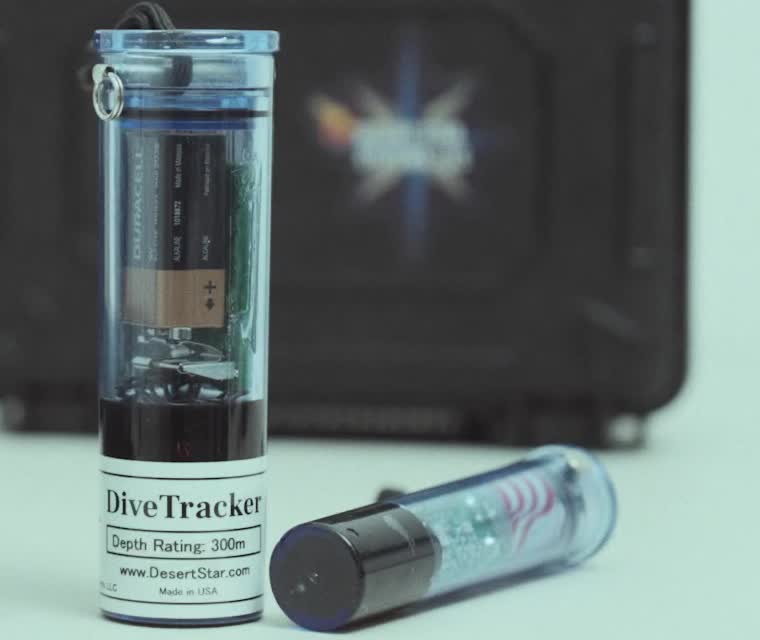 TransmitterReceiver
Scout™ set
- In the set1 transmitter, 1 receiver
- RangeUp to 1,000 ft (305 m)
- BatteriesIncluded (TX: 9 V · RX: 3.6 V lithium)
- Warranty1 year
Sold separately: receiver $350 · transmitter $350 · accessory kit $45 (O-rings, silicone lubricant, lanyard, set pins, O-ring tool)
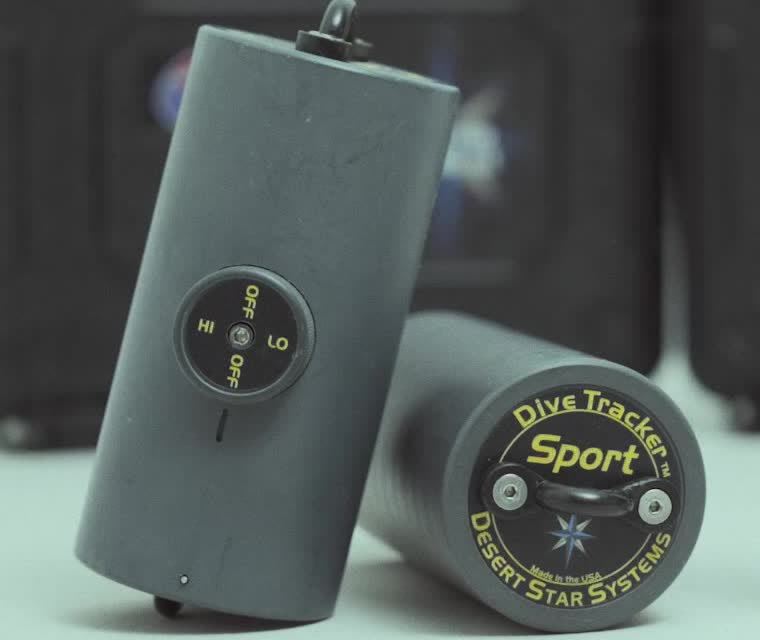 ReceiverTransmitter
Sport™ set
- In the setDTS-TX transmitter, DTS-RX receiver
- RangeUp to 4,000 ft (1,220 m), extended range
- BatteriesIncluded (TX: 6 × AA · RX: 9 V)
- Warranty1 year
Sold separately: receiver $650 · transmitter $650 · accessory kit $75 (O-rings, silicone lubricant, lanyard, set pin, O-ring tool)
Blemished units
New, fully working, lower price.
Sometimes a new Scout or Sport picks up a cosmetic blemish during manufacturing. These units work exactly like any other new DiveTracker and are sold at a lower price.
- New units with a cosmetic blemish only
- 1-year warranty against working defects
- Everything you need to dive with it, batteries included
- Limited and changing availability
Buying several sets for a dive shop, school or team? See the retail and volume price list.
See it underwater
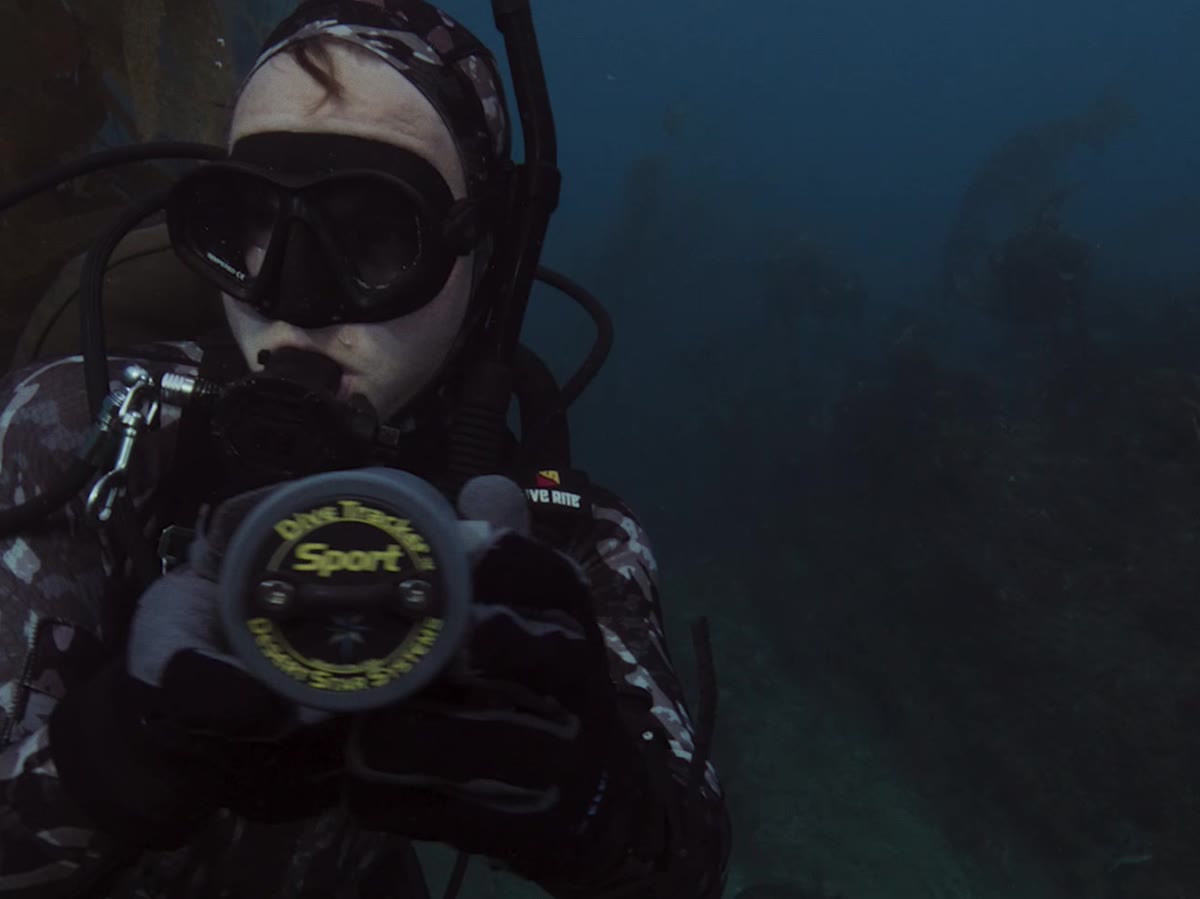
Founder Marco Flagg shows how to navigate with the Sport and the Scout.
How to Navigate with DiveTracker (YouTube).
Reading the display
| Green | About 30–100 ft away (faster blinking means closer) |
| Green + red | About 100–300 ft |
| Red | About 300–1,000 ft |
| Fast green all around | You're within about 20 ft. Swim toward the middle of that arc. |
| More LEDs lit | Stronger signal. Compare readings as you sweep; the strongest is the likely direction. |
| Distance | Read the number above the last lit LED (×10 on HI gain). Treat it as an estimate. |
On the return swim, frequent quick checks of the Scout helps keep me heading straight back to the boat with confidence, and with plenty of air.
Conditions can often be challenging and having the navigational certainty of the Dive Trackers is amazing.
The first time I took it on the boat 3 other people want to get them a set.
Built by a diver
Marco Flagg started DiveTracker after learning to dive in 1988, as a way to find his buddy. A few years later it helped him get back to safety after a great white shark attack.
Watch his story (YouTube) · DiveTracker ExperienceDiver stories
From our Google reviews. Read all reviews on Google
Downloads
- DiveTracker Sport manualOperation, controls, range settings, maintenance (PDF)Download
- DiveTracker Scout quick referenceSetup, NAV light colors, care (PDF)Download
- Sport O-ring maintenanceStep-by-step tutorialOpen
- Sport battery replacementStep-by-step tutorialOpen
- Scout: turning it on and offStep-by-step tutorialOpen
- 11 ways divers use DiveTrackerReal-world examples (PDF)Download
- All manuals and tutorialsIncluding Spanish versionsBrowse
Common questions
Scout or Sport: which should I choose?
Choose Scout if you mostly dive within 1,000 ft of the boat and want the smallest, simplest receiver. Choose Sport if you dive in low visibility, cover longer distances, mark equipment for recovery, or teach and rent gear. Sport has a bigger receiver but adds HI/LO sensitivity, the extended-range setting and a more detailed display.
Where should I put the transmitter?
Hang it on a line about 5 ft below the surface and below the lowest point of the boat's hull, or about 5 ft above the bottom on an anchor line. With Sport, keep it at least 10 ft down and below any thermocline. Keep rocks, reef and the hull out of the signal's path.
How do I care for it?
- Rinse both units in fresh water after every dive.
- Check the O-rings and their seats; keep a thin film of silicone grease on them and replace any O-ring that's cut or nicked.
- Open units only in a clean, dry place, and test them before every dive.
- Remove batteries before storage. Old batteries can leak.
Are batteries included?
Yes. Every set comes with batteries for both the transmitter and the receiver.
What if a unit floods?
Remove the battery right away, rinse the inside with fresh water and let it dry completely, then contact us. Careful O-ring care is the best way to prevent flooding. Check the warranty terms in your manual.
What can limit the signal?
Thermoclines can reflect or block sound. Boat engines and regulator noise can interfere, mostly on Sport's HI gain. Rocks, reef and wrecks block the signal. Swimming pools, small harbors and enclosed spaces create echoes; Sport on LO gain works best there.
Can I buy extra receivers or replacement parts?
Yes. Receivers, transmitters and accessory kits are each sold separately in the shop. Pair receivers with a transmitter of the same model, and ask us before mixing Scout and Sport units.
Need help choosing?
Tell us where and how you dive and we'll recommend a set.
Contact usShop DiveTracker