
Making the Oceans Transparent:
The Significance, Field Validation, and Origins of SonarPoint
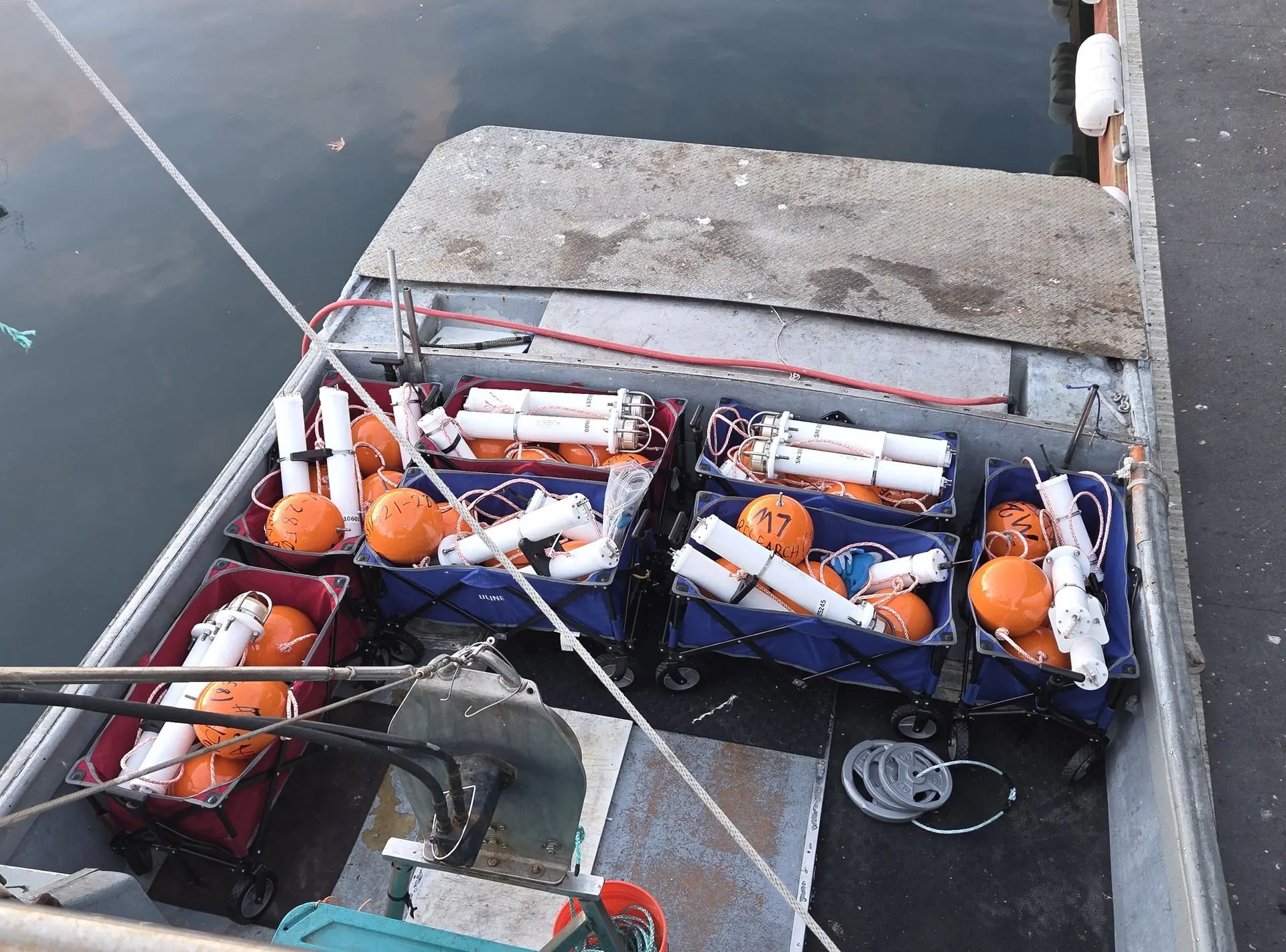
Seven deep-ocean mooring strings loaded onto a fishing boat. Within hours there will be a fully functioning sound signature detection and localizing array monitoring 400 square km, 25 nautical miles offshore at depths up to 1400m.
The ability to track acoustic targets across hundreds of square kilometers of open water has traditionally been limited by the massive cost and infrastructure of fixed, cabled ranges. SonarPoint changes this paradigm, bringing true acoustic transparency to remote environments through deployable, sparse-array passive acoustic monitoring.
The system was originally born from a specialized requirement of the Office of Naval Research (ONR) Marine Mammal Program: the Navy needed a way to generate accurate, long-term cetacean density estimates to evaluate environmental impacts and harassment risks at candidate exercise sites worldwide. Maturing from these ONR origins, the technology is undergoing rigorous field validation and ruggedization under the NAVFAC Living Marine Resources (LMR) program. This testing which is currently nearing conclusion. As part of this testing. SonarPoint's service depth has been extended to 1,800 meters and autonomous recorder spacing expanded from 300 meters out to 8 kilometers.
Field data now demonstrates that a 12-node sparse array—utilizing a 5-node inner array and a 7-node outer array—can achieve precise spatial localization across an 800-square-kilometer footprint. Within this range, low- and mid-frequency signals from baleen and killer whales are reliably tracked up to 16 kilometers from the array center, while the inner array captures higher-frequency delphinid signals. Today, SonarPoint delivers proven, critical data for environmental compliance, while its field-tested architecture establishes a highly promising, scalable framework for emerging national security applications, such as the unconnected monitoring of tactical acoustic signatures in strategic maritime environments.
Where and what in the world's oceans would you like to monitor next?