
SonarPoint Hardware and Mooring String Review
The Mooring String
SonarPoint L-PAM arrays consist of a set of seafloor deployed mooring string. Here is a review of the mooring string elements from top to bottom. The example here is a 1800m rated deep ocean mooring, but you can explore other options via the links that are provided. Note that most mooring components are Desert Star OEM products, providing ease and efficiency of operation while eliminating integration risk.
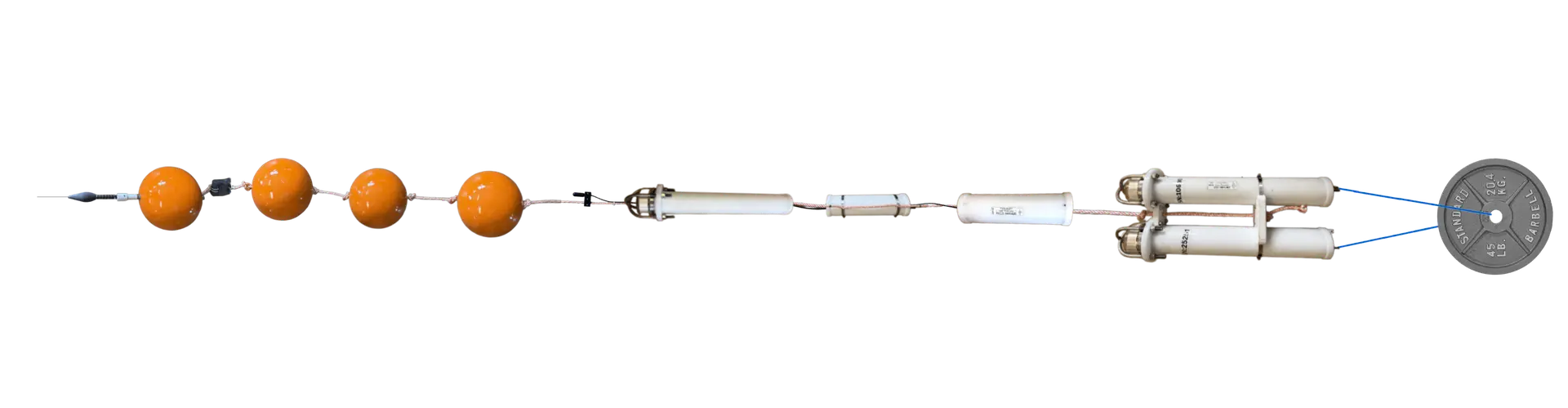
SonarPoint 1800m deep ocean mooring string shown horizontal from top (left) to bottom (right)
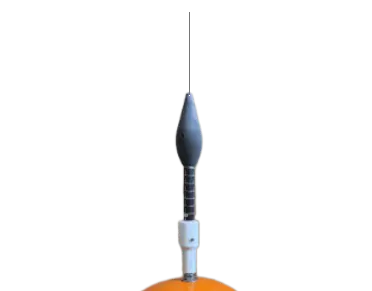
SeaTag Argos & Kineis Satellite Transmitter
A SeaTag satellite transmitter mounted on the top float helps locate a mooring at the surface. Argos & Kineis provide global coverage with positions every 15 minutes. Radio Direction Finding (RDF) is used to home in on the mooring. Solar powered for unlimited endurance. Two versions are recommended. Use SeaTag-LOT as a basic satellite locating tag for the 300m rated mooring strings. Use the larger SeaTag-MOD for 1000m and 1800m depth rated mooring strings. This version includes a sensor suite including precision depth and temperature, 3-axis magnetic field, 3-axis accelerometer and light level. The precision depth is useful when the deployment site depth is uncertain. Precision temperature improves sound speed estimation.

Floats
Our 300m rated mooring strings are lightweight and are equipped with a single or dual 800m service depth rated hard plastic floats. The heavier1000m and 1800m rated mooring strings require more flotation and are delivered with up to four syntactic foam floats. Syntactic foam floats are used at 1000m and beyond, because during the Navy sponsored validation testing of SonarPoint we learned that the hard plastic floats can fail at much less than rated service depth after long exposure due to 'creep failure'. This resulted in dramatic implosions for 1500m rated floats used at 950m-1100m, which the rest of the mooring hardware however survived despite the intense implosion pressure pulse. The solid syntactic foam floats are not subject to catastrophic implosion failure and we have pressure tested the floats to their full 1800m depth rating. Note also the 5 lbs weight below the top float. It works as a counter weight to keep the satellite transmitter upright.

Hydrophone
The 300m and 1000m rated SonarPoint recorders can be equipped with either a housing endcap integrated or a cabled "free field" hydrophone. For the 1800m mooring strings, only the cabled HTI-99-UHF hydrophone is available. The cable mounted hydrophone provides the highest fidelity recordings with "free field" performance and precision calibration. The endcap integrated hydrophones are more rugged and less vulnerable, but experience frequency specific gain variations due to housing resonance effects. The covered frequency range extends from 2 Hz to 250 KHz for HTI, and 10 Hz to 33 KHz or 125 KHz for the endcap integrated versions.
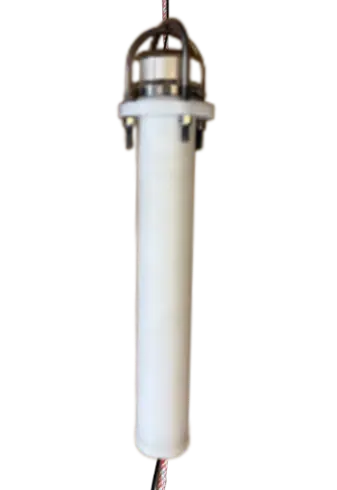
Synchronization Pinger
A SPP series synchronization pinger is an option and can be mounted on one mooring string to correct for clock drift and maintain tight recorder time synchronization throughout an array for an unlimited duration. However, SonarPoint's pre-deployment GPS calibrated and synchronized oscillators exhibit excellent linearity, and clock drift correction is also possible using the deck box with its GPS triggered pinger just before deployment and just after recovery. Read our application note to discover the trade-off. The pinger shown here is the 1800m rated 8-16 KHz SPP1800-12KHz 'low frequency band' pinger with a synchronization range of up to 6km.
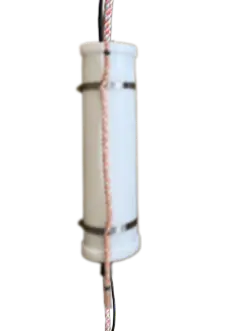
Broad Band Time Synchronized Acoustic Recorder
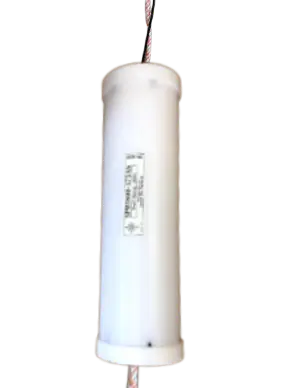
The SP series SonarPoint recorders provide up to eight SD card slots for a total storage capacity of up to 8 TB. This is sufficient for 14 months of continuous recording at 100 KHz sample rate. Max. sample rate is 416 KHz, yielding 208 KHz max. bandwidth. All recorder models include a very precision oscillator, which is pre-deployment calibrated and synchronized via an integrated GPS module. Once calibrated, drift is only 50 parts per billion equivalent to 0.25m signal run time per hour of operation. The drift is also highly linear, enabling a choice of pre- and post-deployment GPS pinger based final synchronization for deployments up to one month (per field validation), or synchronization pinger use for deployments in excess of one month. The recorder shown here is
External Battery
The SPB1800-175Ah rechargeable battery pack is available for long-term monitoring exceeding the battery capacity of the recorder internal battery. For example, the SP300-8, SP1000-8 and SP1800-8 recorders include a 45 Ah capacity internal battery pack that supports about three months of continuous recording when sampling at 100 KHz. By adding the external battery, the recording endurance is extended to about 14 months and supporting an annual equipment service cycle in remote locations.
ARC series Acoustic Release
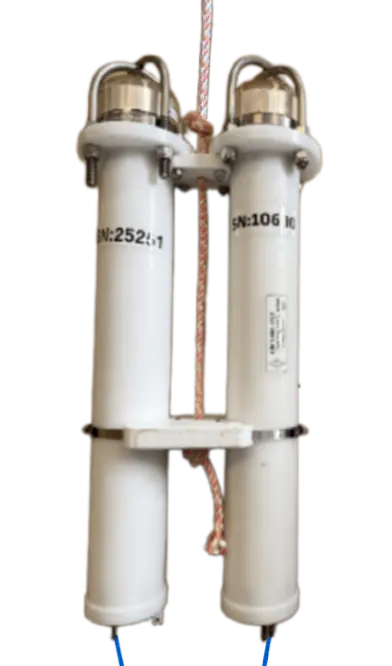
The acoustic release is used to command your mooring back to the surface after a deployment, and to check on mooring status during interim site visits. ARC series acoustic releases use a fast acting and ultra-reliable fusible link mechanism that is extremely resistant to bio-fouling. Multiple acoustic release modes provide a secure and redundant commanding system for challenging conditions. A high precision ranging capability with a 0.1m range resolution lets you position your vessel precisely above and monitor the ascent of the mooring through the water column. It has also been used to recover moorings by robotic undersea vehicle. Dual release brackets are available to meet the permit requirements for sensitive areas such as marine sanctuaries and best assure the recovery of high-value datasets.
Learn about the ARC acoustic release technology
View the available versions of the ARC acoustic release
Sacrificial Weight
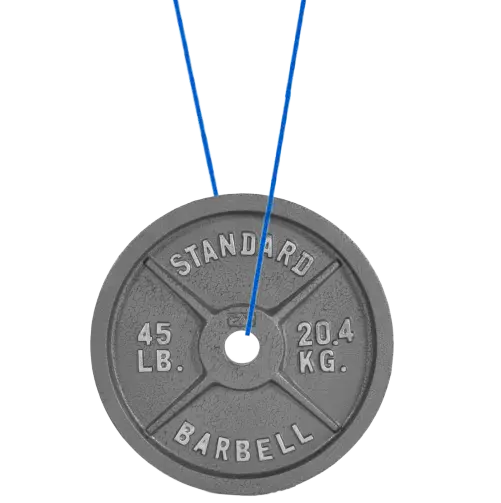
A sacrificial weight is dropped by the ARC and left behind on the seafloor when release is commanded. Sacrificial weights are not delivered with our mooring string, you make your own choice. 45 lbs of weight is enough for all mooring strings and has been tested in currents up to about 1.1 knots. Selection criteria often include environmental factors. Our permit for the SonarPoint work in the Monterey Bay National Marine Sanctuary (MBNMS) specified the use of steel plates, as they will very slowly corrode away and do not harm the environment. We choose gym weight plates for ready availability and convenience. Concrete blocks or sand bags are other options that are used by our many ARC customers.
SonarPoint Deck Gear Review
The Deck Box, GPS Pinger Pole and Over-The-Side Transducer
SonarPoint is operated right from your boat using an integrated kit of deck gear.
- The STM-5 deck box is used both to command the acoustic releases and to operate acoustic array surveys via the GPS pinger pole method. The STM-5 is available in a low frequency band (8-16 KHz) version for large coverage area deep water systems (1000m and 1800m dept rating), and a high frequency band version (34-42 KHz) for compact, smaller coverage area shallow water systems (300m depth rating).
- The pinger pole connects to the STM-5. It includes a GPS sensor for precision timed pings at the top, and a clip to attach the over-the-side transducer at the bottom end.
- The over-the-side sonar transducer is deployed at depths from 2m up to 15m. It provides the acoustic signal for commanding the ARC acoustic releases and emitting the GPS time synchronized pings for acoustic array surveys and recorder re-synchronization functions. The transducer is available in low frequency band and high frequency band variants that match the deck box selection.
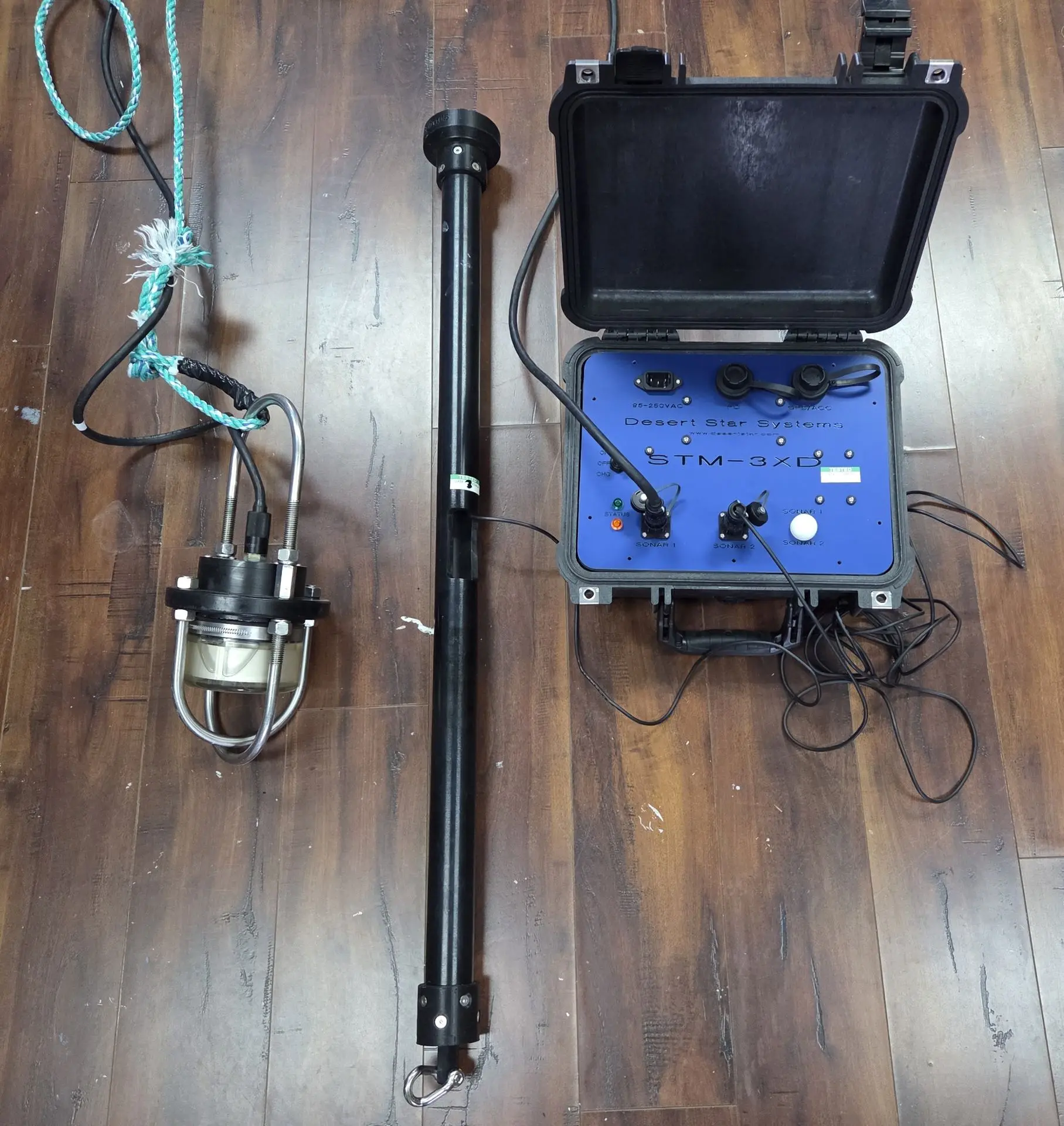
Deck gear including over-the-side transducer (left, low frequency version), GPS pinger pole (center), STM-5 deck box (right)
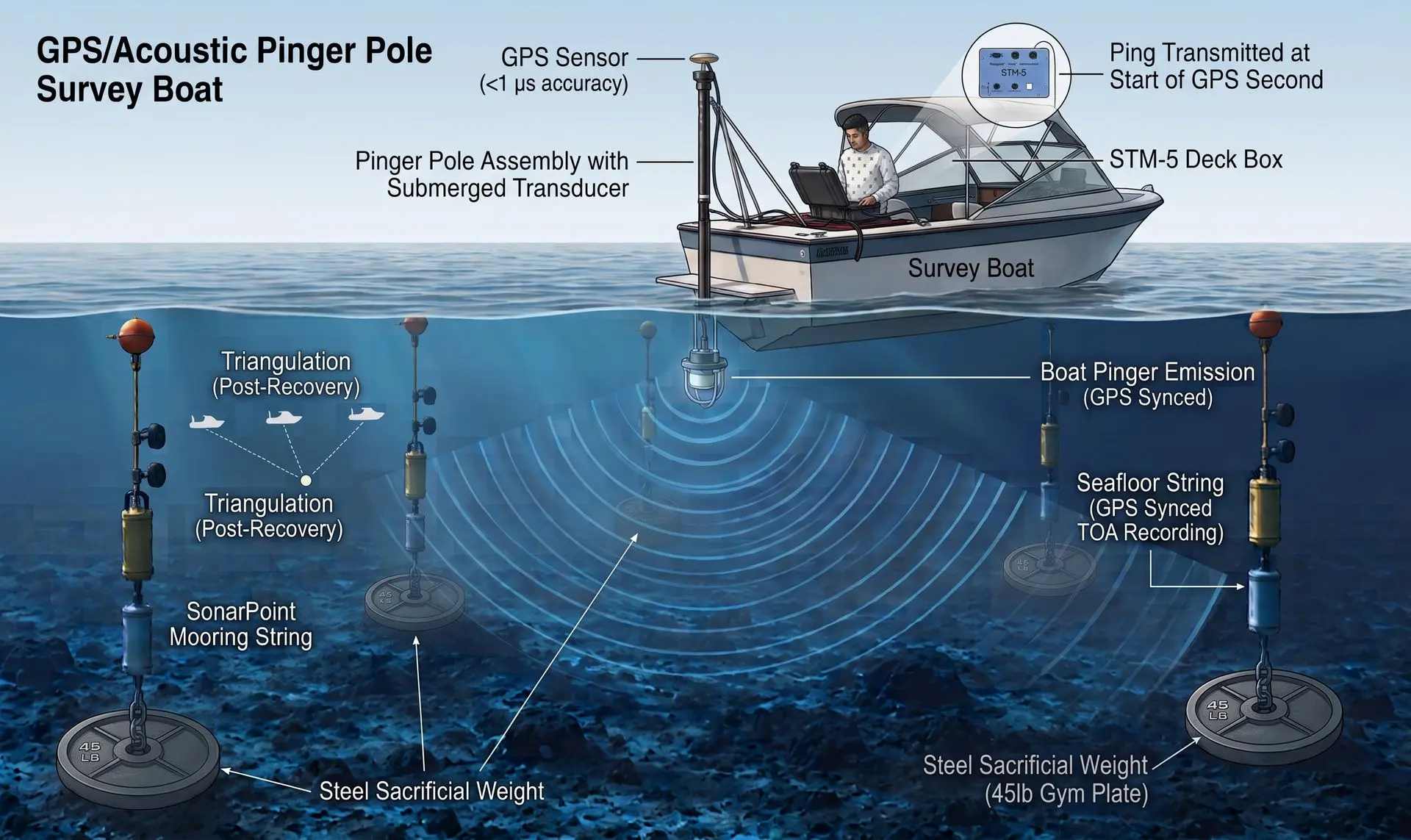
Pinger Pole Operating Concept
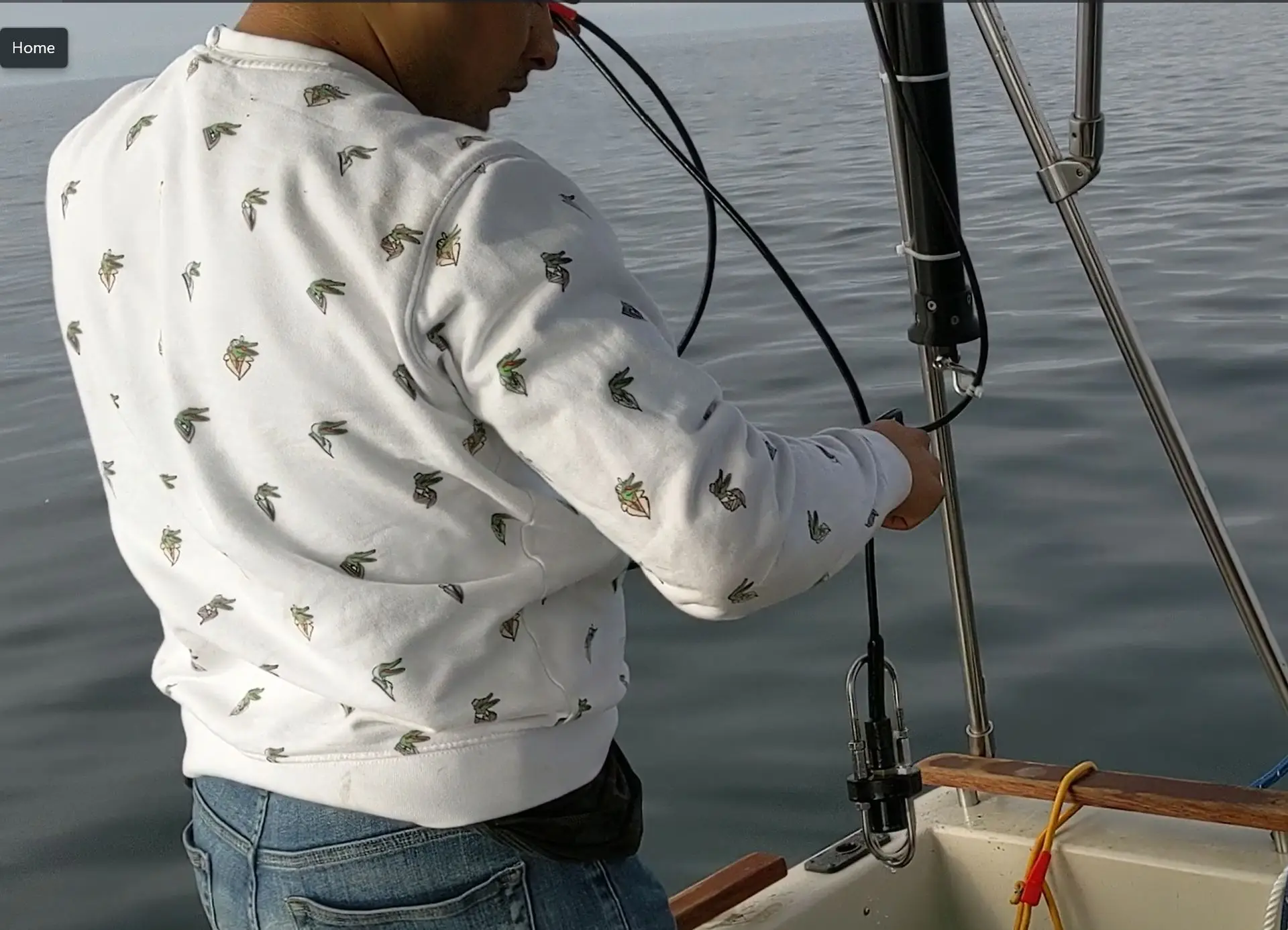
Dunking the over-the side sonar transducer (high frequency band version) adjacent to the GPS pinger pole for best survey accuracy.